
Auto Lockout
Why You Should NEVER Use a Coat Hanger to Unlock Your Car
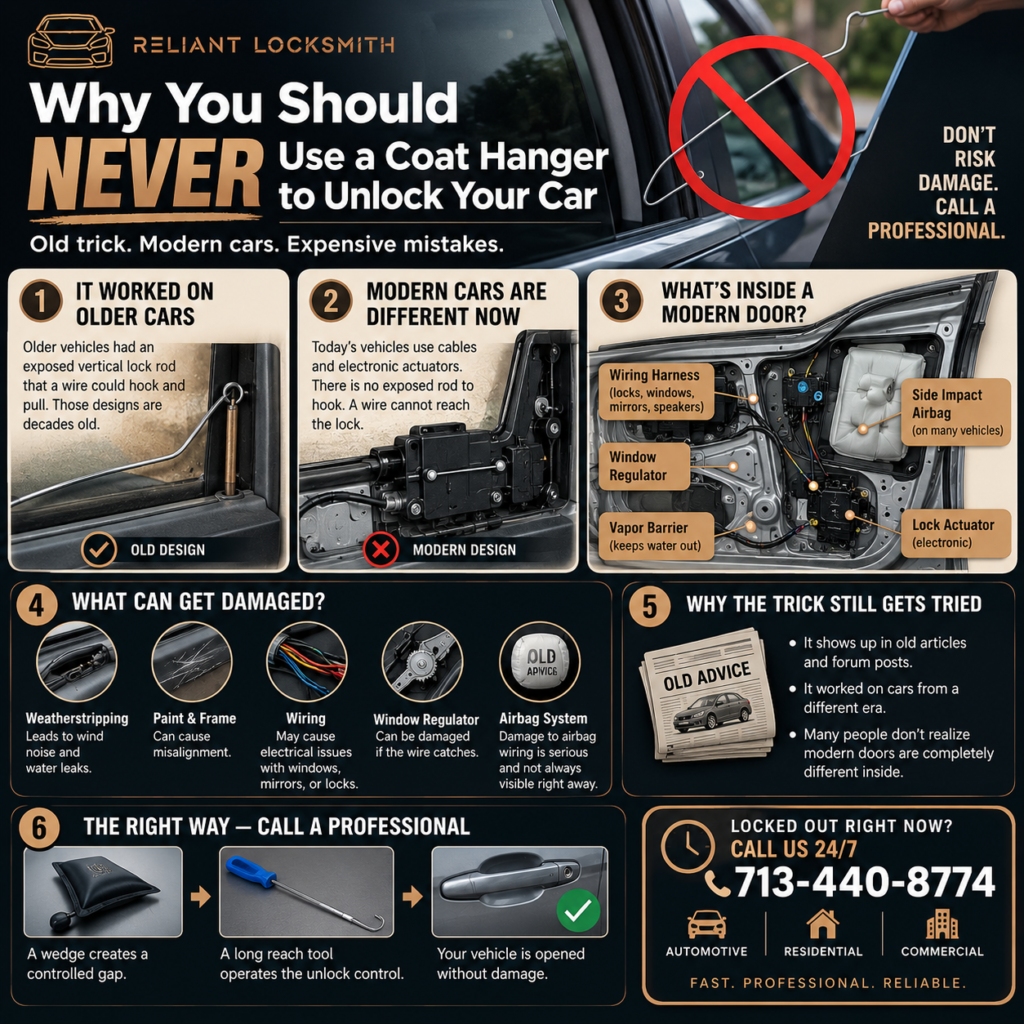
The coat hanger trick worked on a vehicle design that stopped being built decades ago. Here’s why it fails now, and what it damages when people try anyway.
Why it worked, then
Older vehicles had a simple mechanical link between the exterior handle and the door latch. A thin wire pushed through the window channel could reach a vertical rod running straight down to the lock button. The geometry was exposed, accessible, and forgiving of improvised tools. You could feel when the wire caught and a light pull would do the rest.
Why it fails now
Modern vehicles don’t use that exposed rod system. The lock mechanism sits inside a sealed housing, surrounded by door panelling, insulation layers, airbag components, and wiring harnesses. There is no accessible vertical rod. The coat hanger has nowhere useful to go, so it wanders.
What the wire is moving through instead
When someone forces a coat hanger into a modern door, it travels through the window seal, across the inner door panel, and into a space filled with things that were not designed to have metal objects scraped across them: wiring for windows, mirrors, and speakers; the side-curtain airbag module; weatherstripping; and the painted inner door skin. None of this is a lock mechanism. All of it can be damaged.
Where the damage shows up
Window seals stretch or tear, which causes wind noise and water ingress. Wiring insulation gets scored, which can cause intermittent electrical faults months later. Paint on the inner door edge gets scratched. In some vehicles, the side airbag wiring runs close enough to the window channel that it can be disturbed. Bodywork around the window frame gets bent if the wire is levered against it.
None of this damage is visible from outside the car. It shows up later, sometimes long after the person who did it has forgotten the connection.
The trick persists because it used to be true
Automotive advice moves slowly. Someone who successfully used a coat hanger on a 1978 vehicle tells the story for years. The story gets repeated online without a timestamp. Someone reads it facing a locked 2019 car and tries the same thing. The advice was accurate once. It is not accurate now.
The current equivalent
Modern vehicle entry tools are purpose-built for the geometry of current doors. They create a small gap without damaging the seal, and they work in the actual space available without contacting wiring or airbag components. They require training to use correctly on different door designs.
Locked out right now? We run a mobile car unlock
service around the clock, on the vehicle you actually have.
Services
- Automotive Locksmith Services
- Residential Locksmith Services
- Commercial Locksmith Services
Contact Info
- (713) 440- 8774
- support@reliantlocksmith.com
- Serving Houston, TX
- 708 Main Street, Suite 6128 Houston, TX 77002
- Mobile Locksmith Near Me
- Local Locksmith in Houston
- Locksmith Near Me
- Fast Response Locksmith
- Trusted Locksmith Reviews
- Lock Repair Specialist
- Car Key Replacement Near Me