
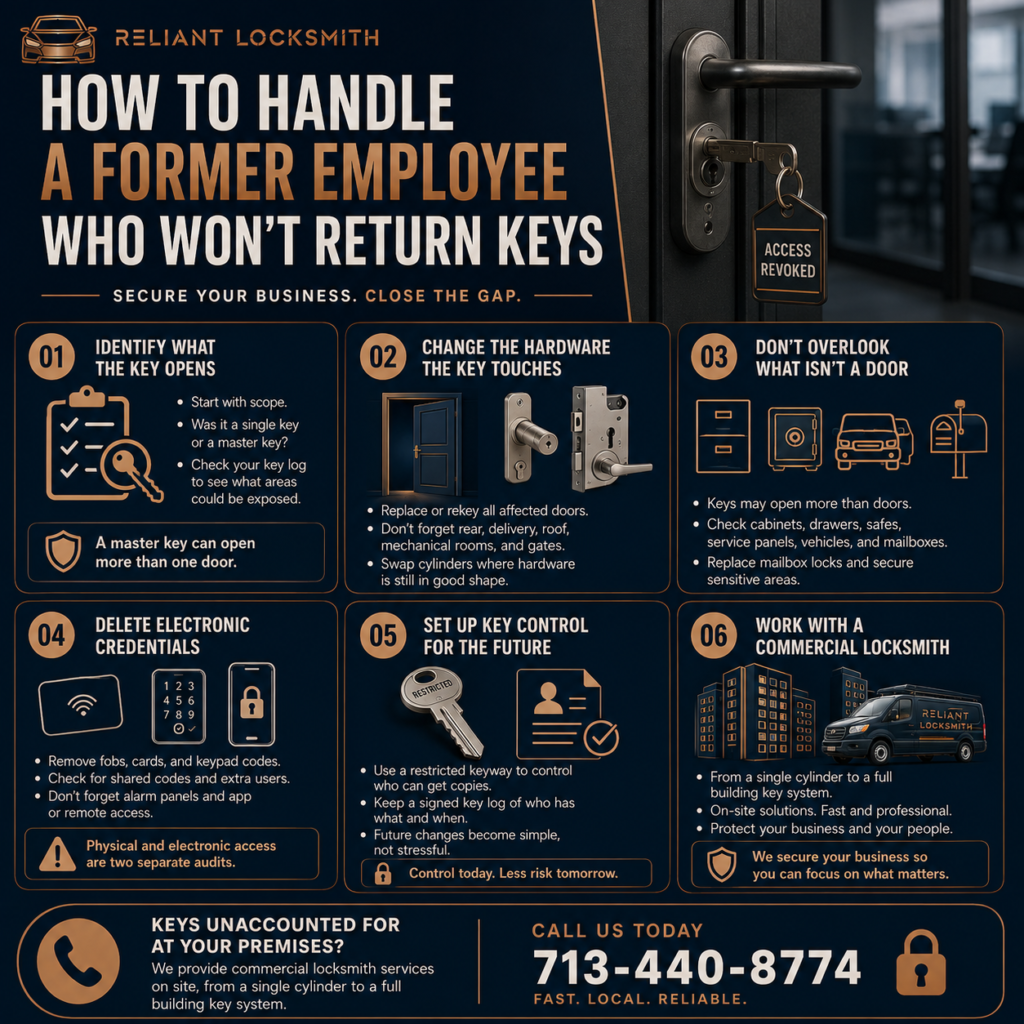
Chasing the key rarely works. Once someone has left on poor terms, the practical question is not how to get the metal back but how to make it stop working, and how far that key reached in the first place.
Work out what the key actually opened
Start with scope, not hardware. A single door key is a contained problem. A master key is not.
On a keyed system, a master opens every cylinder under it, which means one unreturned key can compromise a building rather than an entrance. If your site runs a master key system and the departing employee held anything above the lowest level, the affected cylinders are every cylinder that key operates, not just the door they used daily.
If you keep a key log, this takes minutes. If you do not, this is the moment that becomes obvious.
Change the hardware the key touches
Commercial door lock replacement covers more variety than a house does, and the hardware differs by door type. Storefront and aluminium glass doors typically take mortise lock replacement or a cylinder swap. Steel back-of-house doors usually carry a deadbolt or a cylindrical lockset. Where the existing hardware is sound, lock cylinder replacement changes the keyway without touching the door furniture.
The doors people forget are the ones that face away from the street: rear and delivery entrances, roof access, mechanical and electrical rooms, and any gate or compound lock.
Do not overlook what is not a door
Keys tend to accumulate beyond the building envelope. Depending on the role, that can include filing and stock cabinets, till drawers, a safe, service panels, vehicles, and the mail. Replacing a mailbox lock matters more than it sounds when correspondence carries banking and payroll information.
Electronic credentials are deleted, not replaced
Fobs, cards, and keypad codes are handled in software rather than with tools. Delete the individual credential, then check for shared codes, since a code known to one former employee is usually known to several people. Alarm panel users and any remote or app-based access sit on the same list.
Physical and electronic access are two separate audits. Closing one and not the other leaves the site open.
Set up key control so this is smaller next time
The reason an unreturned key becomes an emergency is that copies are untraceable. A restricted keyway changes that: blanks are controlled, duplication requires authorisation, and copies cannot be cut at a hardware counter. Paired with a signed key log recording who holds what, the next departure becomes an administrative task rather than a call-out.
A commercial locksmith can convert an existing system to restricted keys during the same visit that handles the immediate exposure.
Keys unaccounted for at your premises? We provide commercial locksmith services on site, from a single cylinder to a full building key system.