
Reliant Locksmith · Lock Hardware
Best Commercial Safes for Cash, Documents, and Pharmaceuticals
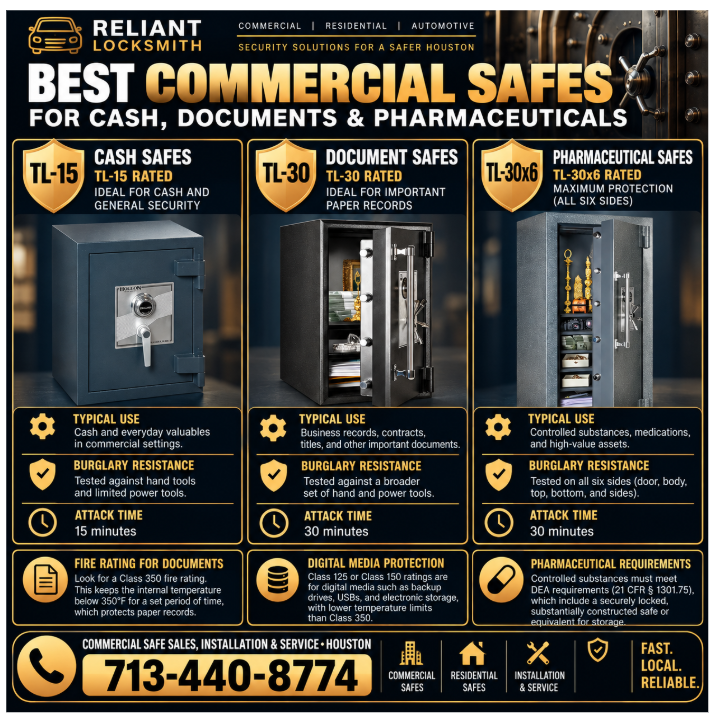
Cash, documents, and pharmaceuticals are each destroyed or stolen by a different threat, so “best safe” is not one answer. A safe rated for burglary resistance is not the same safe rated for fire, and a pharmacy has a legal storage requirement the other two don’t.
Cash: burglary rating is what matters
Cash is a theft target, not a fire or heat concern unless it’s the only thing in the safe. The rating to look at is UL’s burglary classification, which grades how long a safe resists forced entry with tools.
- TL-15: Steel construction equivalent to 1 inch of solid steel, tested against roughly 15 minutes of continuous working time by a technician using hand and power tools.
- TL-30: The same style of attack, extended to 30 minutes, with a broader tool set permitted.
- TL-30×6: A TL-30 rated safe tested on all six sides, including the floor and back, not just the door.
A business handling cash on site, such as a retail counter or restaurant, is generally looking at a TL-15 at minimum, with TL-30 for higher cash volumes or overnight holds.
Documents: fire rating is what matters
Paper is destroyed by heat long before a safe’s structure fails. UL’s fire classifications are built around that: a Class 350 safe is tested with its exterior heated to 1,550°F while the interior is held below 350°F, since paper starts to char above roughly 410°F. Ratings are given in time increments, such as ½-hour, 1-hour, or 2-hour, based on how long that interior temperature is maintained.
Digital media and backup drives need a different rating. Class 125 and Class 150 safes are built for data protection and hold the interior to a lower ceiling, 125°F or 150°F, because electronic media is damaged at temperatures paper tolerates.
A document safe and a cash safe solve different problems, so a combination burglary-and-fire rated unit is the common choice when both risks apply to the same room.
Pharmaceuticals: a legal requirement, not just a rating
Storage of controlled substances by a pharmacy is governed by DEA regulation, specifically 21 CFR § 1301.75, not by a burglary or fire rating alone.
Schedule I through V controlled substances must be kept in a securely locked, substantially constructed cabinet, or dispersed through the pharmacy’s general stock in a way that deters theft. A small number of substances, including thiafentanil and carfentanil, carry a stricter requirement: storage in a safe or steel cabinet equivalent to a U.S. Government Class V security container.
In practice, most pharmacies use a dedicated, bolted-down, burglary-rated cabinet or safe that also satisfies the “substantially constructed” standard, since that language is a performance requirement rather than a specific product listing. A commercial locksmith can confirm whether an existing cabinet or safe meets that standard for a given state board or DEA inspection.
Choosing by what's actually inside
The mistake is buying one safe for a room and assuming it covers everything in it. Cash calls for burglary resistance. Paper calls for a fire rating matched to how long a fire could burn before it’s discovered. Controlled substances call for meeting a specific regulatory standard, not just a UL label. Where more than one of these applies in the same location, that’s a combination-rated safe or more than one unit, not a single all-purpose rating.
Choosing or installing a commercial safe? Reliant Locksmith fits and services safes for cash, records, and regulated storage at businesses across Houston. Call (713) 440-8774.
Services
- Automotive Locksmith Services
- Residential Locksmith Services
- Commercial Locksmith Services
Contact Info
- (713) 440- 8774
- support@reliantlocksmith.com
- Serving Houston, TX
- 708 Main Street, Suite 6128 Houston, TX 77002
- Mobile Locksmith Near Me
- Local Locksmith in Houston
- Locksmith Near Me
- Fast Response Locksmith
- Trusted Locksmith Reviews
- Lock Repair Specialist
- Car Key Replacement Near Me