
Reliant Locksmith · Lock Types
Electronic vs. Mechanical Locks: Which Is Faster in an Emergency?
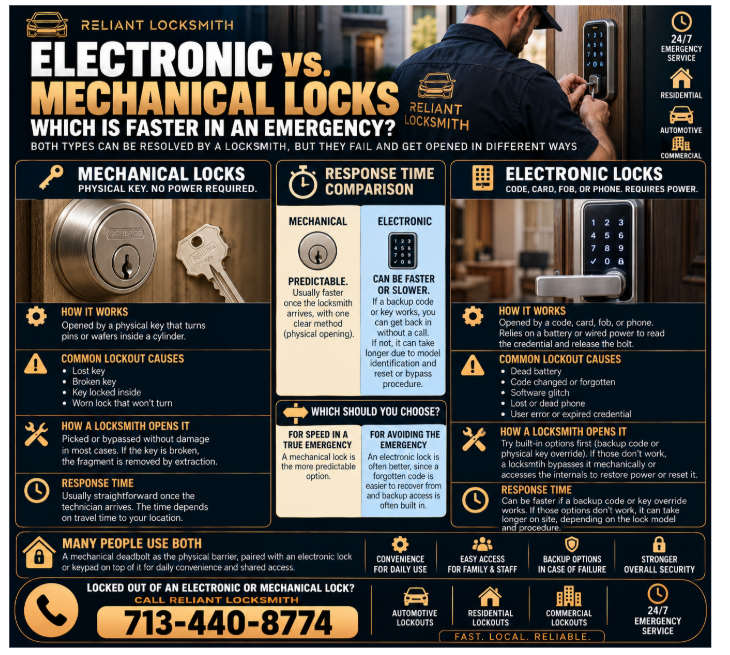
A lockout is a different problem depending on what kind of lock is on the door. A mechanical lock and an electronic lock fail differently, get bypassed differently, and leave a locksmith with a different job to do once called.
How each lock is operated
A mechanical lock is opened by a physical key turning pins or wafers inside a cylinder. Nothing about it depends on power. It works the same at year ten as it did on day one, provided the hardware itself is sound.
An electronic lock is opened by a code, a card, a fob, or a phone, and it relies on a battery or wired power to read that credential and release the bolt. The mechanical bolt is still there doing the physical locking, but something electronic decides when it moves.
What causes the lockout
With a mechanical lock, the usual causes are a lost or broken key, a key locked inside, or a worn lock that will no longer turn. The lock itself rarely fails on its own.
With an electronic lock, the lock can fail even when nothing is lost. A dead battery, a software glitch, a code that was changed and not communicated, or a dead phone when the credential lives in an app are all lockouts caused by the lock, not by a missing key.
Getting back in during a lockout
A mechanical lock is opened by picking or bypassing the cylinder, which a trained locksmith can generally do without damaging the door or the lock. If the key is broken off inside, it is removed by extraction. Either way, the method is physical and does not depend on anything being charged or connected.
An electronic lock gives you more entry paths to try before calling anyone. Most keypad and smart locks include a physical key override, a backup code, or a manual key port behind the faceplate, specifically for a dead battery or a software fault. When those built-in options do not work, or none exist on that model, a locksmith is called to bypass the lock mechanically in much the same way as a standard cylinder, or to access the lock’s internals to restore power or reset it.
Response time in practice
A mechanical lockout has one path to resolution: a locksmith opens the physical lock. Response time is whatever it takes to get a technician to the door.
An electronic lockout sometimes resolves faster, because a backup code or key override lets you back in without a call at all. When those options are exhausted, though, electronic hardware can take longer on site, since the technician may need to identify the lock model and its specific bypass or reset procedure before starting, rather than working on a standard cylinder.
Which to choose
For speed in a true emergency, where the deciding factor is how fast a locksmith can get you through the door, a mechanical lock is the more predictable option. For avoiding the emergency in the first place, an electronic lock is often the better pick, because a forgotten code is easier to recover from on your own than a lost key, and backup access is often built into the hardware.
Many households and businesses end up running both: a mechanical deadbolt as the physical barrier, paired with an electronic lock or keypad on top of it for daily convenience and shared access.
Locked out of an electronic or mechanical lock? Call Reliant Locksmith at (713) 440-8774. We handle both types on site, for homes and businesses.
Services
- Automotive Locksmith Services
- Residential Locksmith Services
- Commercial Locksmith Services
Contact Info
- (713) 440- 8774
- support@reliantlocksmith.com
- Serving Houston, TX
- 708 Main Street, Suite 6128 Houston, TX 77002
- Mobile Locksmith Near Me
- Local Locksmith in Houston
- Locksmith Near Me
- Fast Response Locksmith
- Trusted Locksmith Reviews
- Lock Repair Specialist
- Car Key Replacement Near Me