
Pro Tips
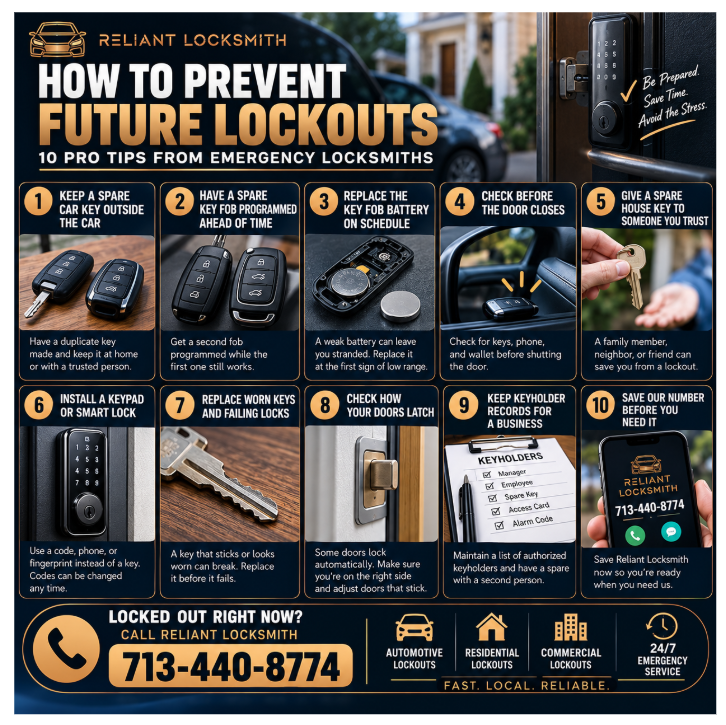
How to Prevent Future Lockouts: 10 Pro Tips From Emergency Locksmiths
Most emergency lockout calls come from the same handful of situations: keys left inside a car, a house door that latched behind someone, a key fob with a dead battery, or a lost key with no spare to replace it. Locksmiths who work lockouts around the clock see the same patterns repeatedly, and the prevention comes down to ten habits and upgrades.
1. Lockout Services
A spare car key is what separates a short delay from a call for car unlock service. Have duplicate car keys made through a key duplication service while you still have a working key. A copy is simpler to produce than a replacement made from scratch after every key is lost, and it should be kept with a trusted person or at home, not inside the vehicle.
2. Have a spare key fob programmed ahead of time
A spare key fob is more than a cut key. Modern vehicles require car key programming so the fob communicates with the immobilizer. Having a second fob programmed while the first still works avoids an all keys lost situation and the full key replacement that comes with it.
3. Replace the key fob battery on schedule
A weak battery shortens the range of keyless entry remote functions, then stops them. Most fobs give warning signs first, such as reduced range or repeated button presses. Replacing the battery at the first sign is quicker than a call to a mobile locksmith.
4. Build a habit of checking before the door closes
Most people who call about being locked out of their car locked the keys inside within seconds of stepping out. Check for keys, phone, and wallet before shutting the door. On vehicles with push button start, keep the fob on your person rather than in a bag or cup holder, since a fob left inside can lead to locked keys in the car.
5. Give a spare house key to someone you trust
A house lockout is resolved quickly when a family member, neighbor, or friend holds a spare. Hiding a key outside is not a reliable alternative, since a hiding spot known to you is not hard for others to find.
6. Install a keypad or smart lock
Keypad deadbolts and smart locks open with a code, a phone, or a fingerprint instead of a key, which removes the key as the point of failure. Codes can be changed or deleted at any time, so they are also useful for guests and contractors. A residential locksmith can fit one to most standard doors.
7. Replace worn keys and failing locks
A key that sticks, turns hard, or has visibly worn edges is a lockout waiting to happen, since it can break off in the cylinder. Copies made from copies wear faster than keys cut from the original. Lock replacement or a new cylinder is simpler than a key extraction call, and a lock that no longer turns smoothly should be changed before it fails.
8. Check how your doors latch
Knob locks with push buttons, sliding patio doors, and self-latching deadbolts lock automatically or with a light push. Before closing a door behind you, confirm you are on the right side of it. Doors that stick or latch inconsistently should be adjusted so they behave the same way every time.
9. Keep keyholder records for a business
A commercial lockout or business lockout is most often caused by a key that is unaccounted for or held by only one person. Keep an updated list of authorized keyholders, hold a spare with a second authorized person, and use access control credentials, such as fobs or cards, that can be disabled individually. Businesses leasing space should also keep lease terms and landlord contact details on hand so lockouts at the premises are resolved by the right party.
10. Save Reliant Locksmith’s number before you need it
Searching for an emergency locksmith near me while stranded takes time and attention that is better spent elsewhere. Save Reliant Locksmith, a local 24 hour locksmith for automotive, residential, and commercial lockouts, in your phone now: (713) 440-8774. Know your exact address or location when you call, since emergency lockout service starts with where the technician is headed.
Locked out right now? Call Reliant Locksmith at (713) 440-8774. We provide emergency lockout service around the clock for cars, homes, and businesses, along with spare key fobs, car key programming, and lock replacement to keep it from happening again.
Services
- Automotive Locksmith Services
- Residential Locksmith Services
- Commercial Locksmith Services
Contact Info
- (713) 440- 8774
- support@reliantlocksmith.com
- Serving Houston, TX
- 708 Main Street, Suite 6128 Houston, TX 77002
- Mobile Locksmith Near Me
- Local Locksmith in Houston
- Locksmith Near Me
- Fast Response Locksmith
- Trusted Locksmith Reviews
- Lock Repair Specialist
- Car Key Replacement Near Me